
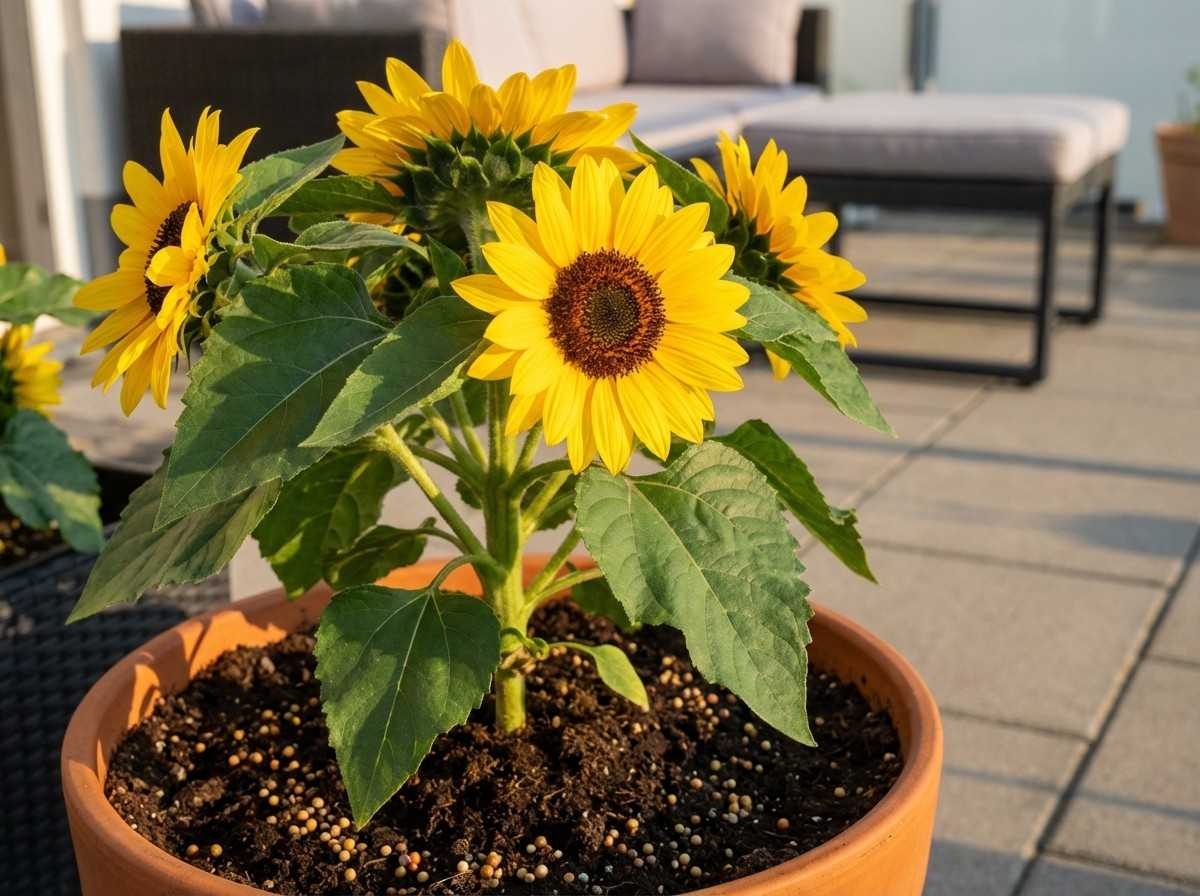
There’s something genuinely magical about watching a dwarf sunflower open up – that burst of gold and amber right on your patio, balcony, or windowsill. If you’ve ever grown these compact beauties, you already know they punch well above their weight in terms of personality.
But you’ve probably also noticed that getting them to bloom their absolute best takes a little more than just sunlight and water. The right fertilizer, applied the right way at the right time, is what separates a “pretty good” sunflower from one that genuinely stops people in their tracks.
This guide is written for real gardeners – people who want honest, practical advice without the fluff. Whether you’re a first-time container gardener or a seasoned grower looking to get more out of your dwarf varieties, everything you need to know about feeding dwarf sunflowers for maximum flowering is right here.
Why Fertilizing Dwarf Sunflowers Is Different from Regular Sunflowers
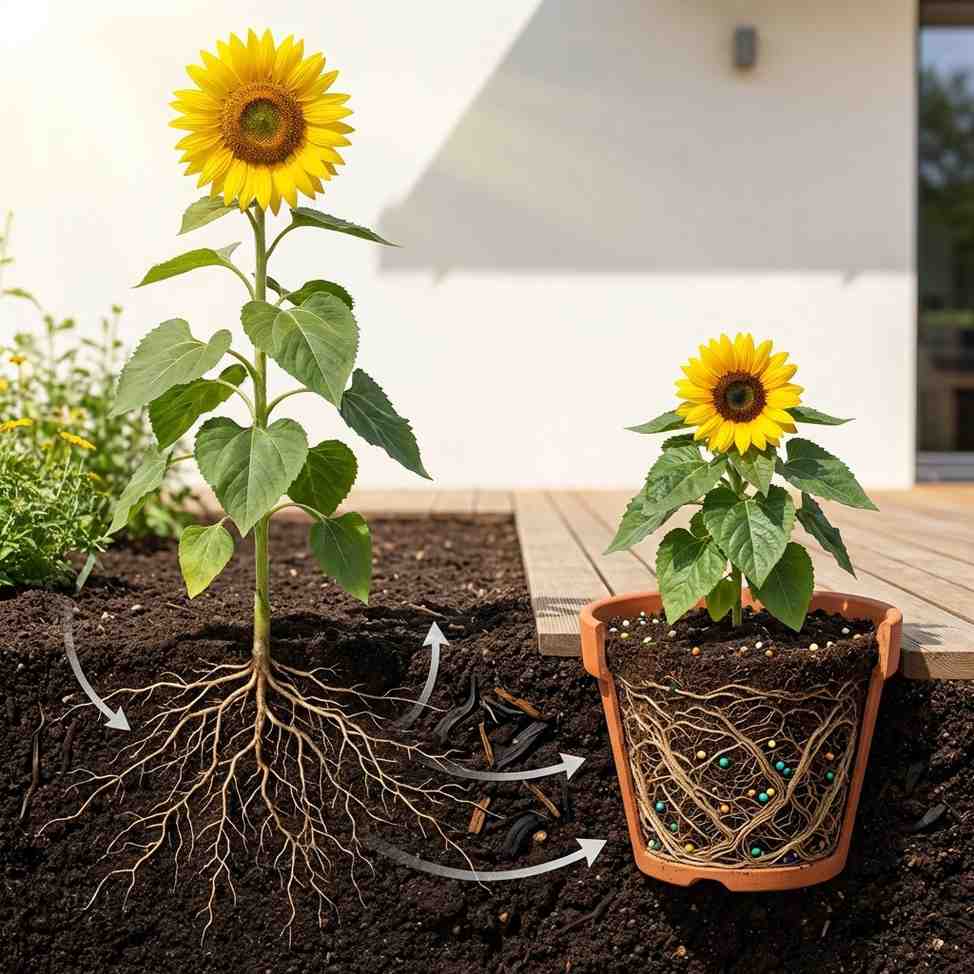
Dwarf sunflowers share the same botanical family as their towering cousins (Helianthus annuus), but their needs are distinctly different. Full-size sunflowers grown in garden beds can draw nutrients from deep soil layers. Dwarf varieties – especially those grown in pots and containers – are confined to a limited root zone and depend entirely on what you provide.
A few key differences to keep in mind:
- Smaller root zone = nutrients deplete faster
- Container growing = frequent watering flushes nutrients out of soil.
- Compact size = plant energy is concentrated into bloom production rather than height.
- Multiple blooms on many dwarf varieties means continuous nutrient demand
Understanding these differences will help you choose the right fertilizer type, timing, and application rate.
Choosing the right Dwarf Sunflower variety also plays a big role in how well your plant performs in containers. Some dwarf sunflowers are naturally better suited for small pots and produce more consistent blooms.
If you’re unsure which one to grow, check out these best dwarf sunflower varieties for small pots to get better results from the start.
NPK Ratios Fertilizer for Dwarf Sunflower Flowering
Every fertilizer label shows three numbers – the NPK ratio. These stand for Nitrogen (N), Phosphorus (P), and Potassium (K). Each plays a specific role in plant development, and for flowering, the balance matters enormously.
| Nutrient | Role | Best For |
|---|---|---|
| Nitrogen (N) | Leaf and stem growth | Vegetative/early growth stage |
| Phosphorus (P) | Root development and flower production | Budding and flowering stage |
| Potassium (K) | Overall plant health and stress resistance | Throughout growing season |
What This Means for Dwarf Sunflowers
The biggest mistake growers make is using a high-nitrogen fertilizer all season long. Nitrogen encourages lush green growth – but in excess during the flowering phase, it actually suppresses blooms. Your plant will look healthy and leafy while producing fewer flowers.
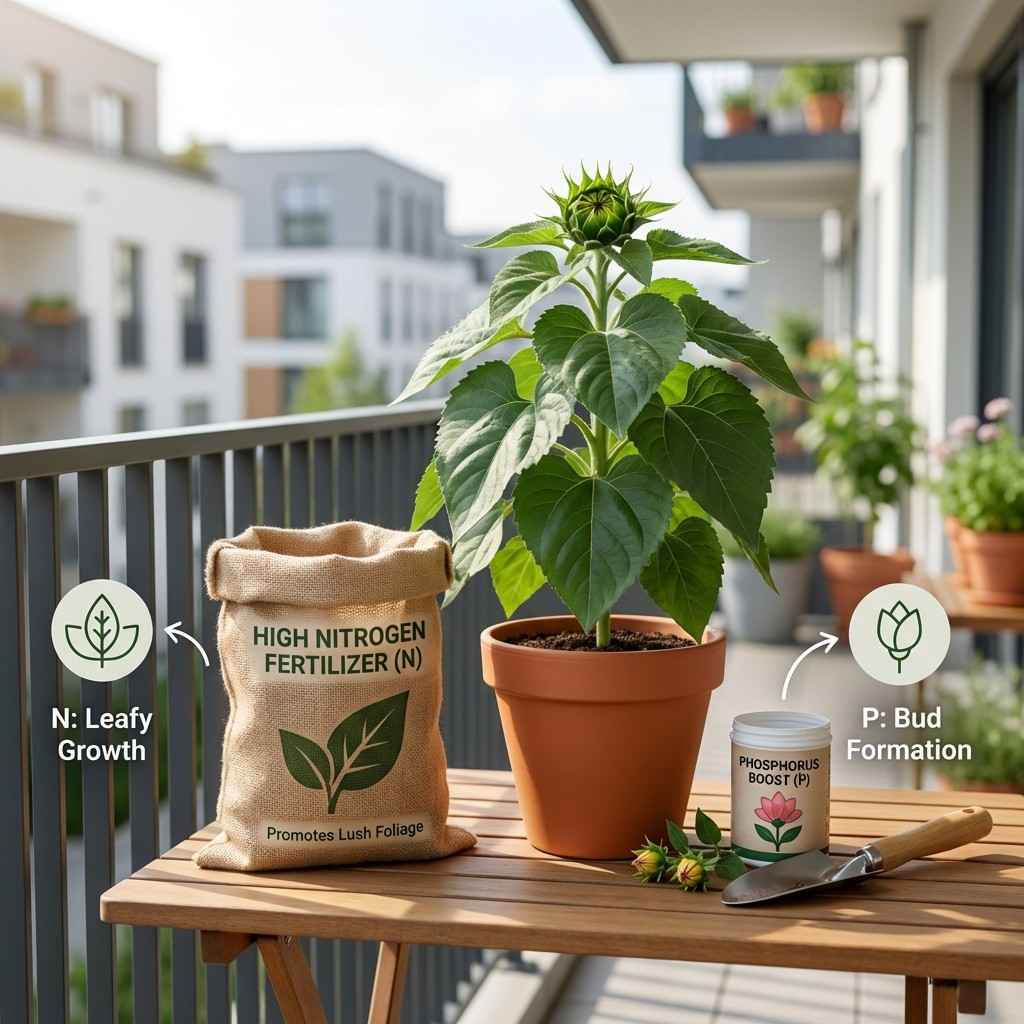
If your dwarf sunflower not blooming even after regular feeding, the issue is often too much nitrogen at the wrong stage. Switching to a phosphorus-rich fertilizer at the right time can quickly trigger bud formation and improve flowering.
The golden rule: Start with a balanced fertilizer during the vegetative stage, then transition to a high-phosphorus formula as buds begin to form.
Best Fertilizer for Dwarf Sunflower Flowering
1. Granular Slow-Release Fertilizers (Best for Beginners)
Slow-release granular fertilizers are mixed into the soil at planting time or top-dressed periodically. They break down gradually, delivering a steady stream of nutrients over weeks or months.
Best NPK range for early growth: 10-10-10 or 14-14-14
Pros:
- Easy to apply – no measuring or mixing.
- Feeds consistently without risk of nutrient spikes.
- Great for busy gardeners.
Cons:
- Less control over timing.
- Can’t quickly adjust if plant shows deficiency.
Top picks:
- Osmocote Plus Smart-Release Plant Food (15-9-12)
- Scotts Continuous Release Balanced Plant Food
2. Liquid Fertilizers (Best for Flowering Boost)
Liquid fertilizers are dissolved in water and applied during regular watering. They’re fast-acting and ideal for giving your dwarf sunflowers a targeted bloom boost.
Best NPK range for flowering: 5-10-10, 10-30-20, or 0-50-30 (bloom formulas)
Pros:
- Nutrients available to the plant within 24–48 hours.
- Easy to adjust concentration.
- Perfect for container-grown plants.
Cons:
- Needs more frequent application (every 1–2 weeks)
- Risk of over-fertilization if not measured carefully
Top picks:
- Jack’s Classic Blossom Booster (10-30-20)
- Fox Farm Big Bloom Liquid Plant Food.
- Miracle-Gro Bloom Booster Flower Food (10-52-10)
3. Organic Fertilizers (Best for Long-Term Soil Health)
If you’re growing dwarf sunflowers season after season in the same containers, organic fertilizers support not just the plant but the microbial ecosystem in the soil. They release nutrients slowly as they break down and rarely cause fertilizer burn.
Best options:
- Fish emulsion (5-1-1) – excellent nitrogen source for early growth.
- Bone meal (3-15-0) – high phosphorus, great bloom booster.
- Kelp meal – provides micronutrients and potassium.
- Worm castings – gentle, all-purpose, safe for seedlings
Pros:
- Virtually no risk of burning roots.
- Improves soil structure over time.
- Environmentally friendly.
Cons:
- Slower results.
- Some (like fish emulsion) have a strong smell.
4. Granular Bloom Fertilizers (Best Mid-Season Switch)
When you see the first signs of budding – small green nubs forming at the base of leaves – it’s time to switch to a bloom-specific granular formula. These are high in phosphorus and potassium with reduced nitrogen.
Best NPK range: 5-10-10 or 3-12-12
Top picks:
- Dr. Earth Organic Bud & Bloom Booster (3-9-4)
- Espoma Flower-Tone (3-4-5)
- Jobe’s Organics Bone Meal (2-14-0)
Fertilizer Application Schedule: Week-by-Week Guide
Timing is everything. Here’s a practical schedule for dwarf sunflowers grown in containers:
| Growth Stage | Timing | Fertilizer Type | NPK Focus |
|---|---|---|---|
| Planting / Seedling | Week 1–2 | Slow-release granular or diluted liquid | Balanced (10-10-10) |
| Vegetative Growth | Week 3–5 | Liquid fertilizer every 2 weeks | Slightly N-heavy (balanced to 5-10-5) |
| Pre-budding | Week 6–7 | Switch to bloom formula | High P (10-30-20) |
| Budding & Flowering | Week 8–12+ | Liquid bloom booster every 10–14 days | High P + K (5-10-10) |
| Late Season | Final weeks | Reduce or stop fertilizing | Allow natural senescence |
Pro Tip: Always water your plant thoroughly before applying liquid fertilizer. Applying fertilizer to dry soil can concentrate salts around roots and cause root burn – even with gentle formulas.
Signs Your Dwarf Sunflower Needs More Fertilizer
Plants are excellent communicators if you know what to look for. Watch for these signals:
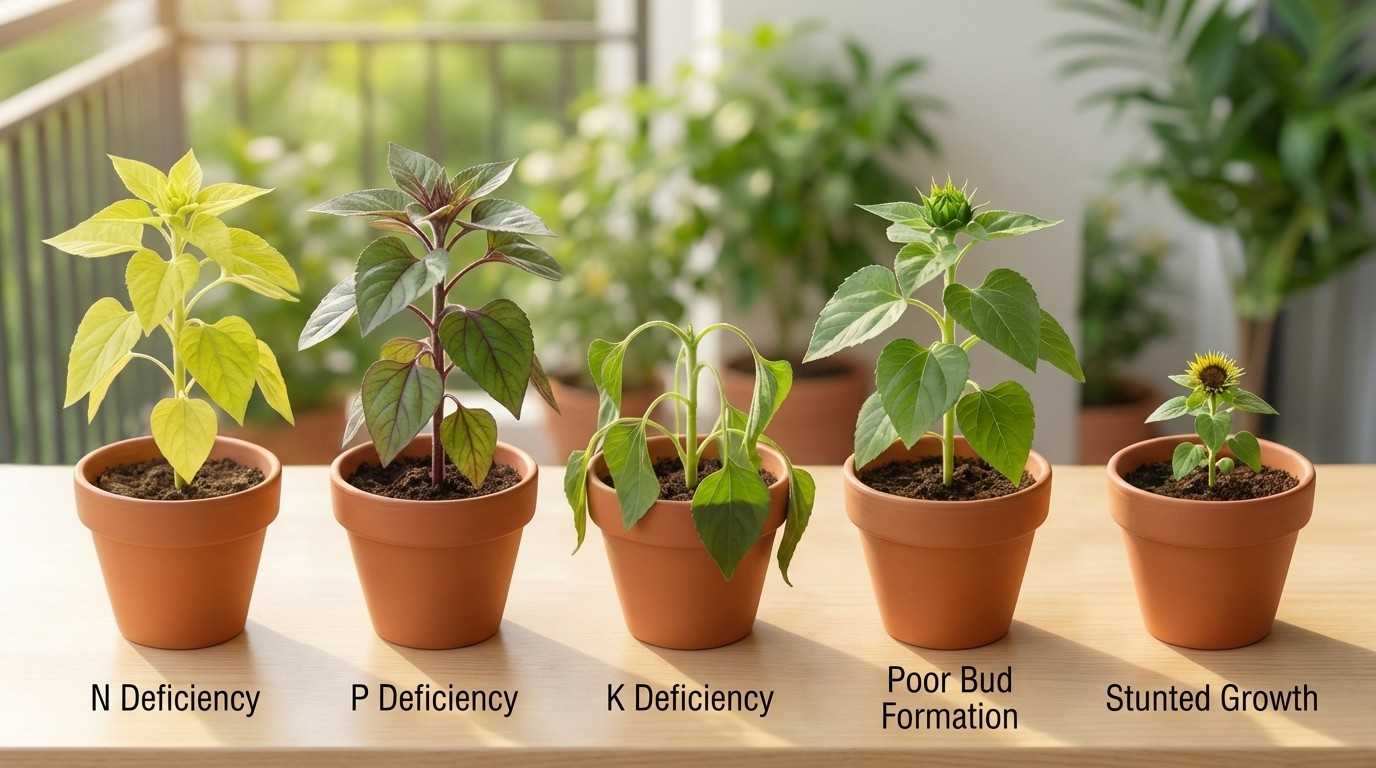
- Pale yellow-green leaves – nitrogen deficiency; increase feeding frequency.
- Purple-tinged stems or leaves – phosphorus deficiency; switch to bloom formula.
- Weak stems that flop over – potassium deficiency; add a K-rich fertilizer.
- Slow or no bud development – likely needs a phosphorus boost.
- Stunted overall growth – may need a full balanced feeding reset
Signs of Over- Fertilization
More is not always better. Over-feeding is one of the most common mistakes with container-grown dwarf sunflowers. Here’s what to watch for:
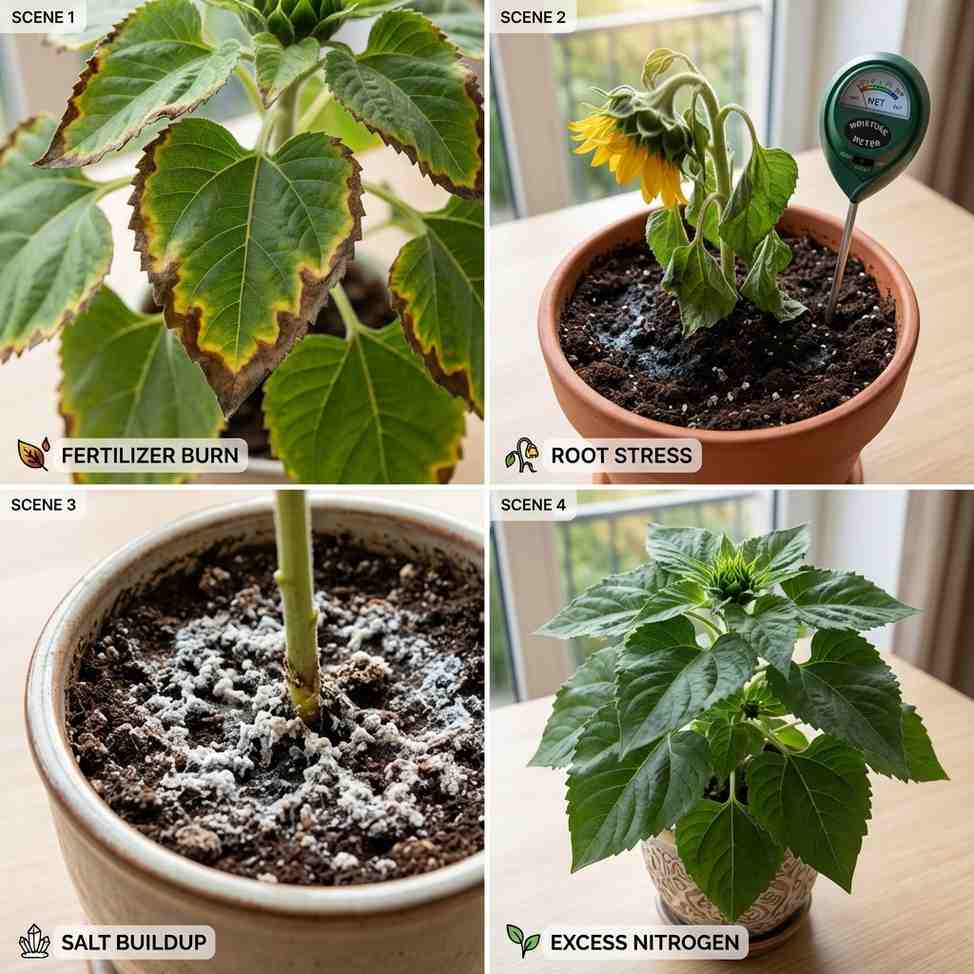
- Brown, crispy leaf edges – fertilizer salt burn.
- Wilting despite adequate watering – root damage from salt buildup.
- White crusty residue on soil surface – mineral salt accumulation.
- Excess lush foliage with few blooms – too much nitrogen.
Fix: Flush the container thoroughly with plain water – pour water through until it runs clear from the drainage holes. This leaches excess salts. Then wait 1–2 weeks before resuming fertilization at half the recommended dose.
Micronutrients That Make a Big Difference
Most gardeners focus only on NPK, but micronutrients quietly play a significant role in bloom quality and color vibrancy for dwarf sunflowers.
| Micronutrient | Role | Source |
|---|---|---|
| Iron (Fe) | Prevents yellowing between leaf veins | Chelated iron spray or acidic soil amendments |
| Magnesium (Mg) | Chlorophyll production, deeper green leaves | Epsom salt (1 tbsp per gallon of water) |
| Calcium (Ca) | Cell wall strength, prevents tip burn | Lime, gypsum, or cal-mag supplements |
| Boron (B) | Pollen development and seed set | Trace amounts in quality balanced fertilizers |
| Zinc (Zn) | Enzyme activity and growth regulation | Found in most complete fertilizers |
A monthly foliar spray with a diluted seaweed extract or a complete micronutrient solution can noticeably improve bloom size and petal color in dwarf sunflowers.
Organic vs. Synthetic Fertilizers: Which Is Better?
Honestly? Both work – the “best” choice depends on your priorities.
| Factor | Organic | Synthetic |
|---|---|---|
| Speed of results | Slow (weeks) | Fast (days) |
| Risk of burn | Very low | Moderate to high |
| Soil health benefit | High | Low to none |
| Cost | Moderate | Low to moderate |
| Environmental impact | Lower | Higher |
| Ease of use | Moderate | Easy |
| Precision | Lower | Higher |
Our recommendation: Use a slow-release organic granular at planting, and supplement with a liquid bloom booster (organic or synthetic) during the flowering phase. This hybrid approach gives you the soil-health benefits of organics with the precision and speed of synthetics when blooms matter most.
Best Fertilizer For Dwarf Sunflower Flowering: Quick-Reference Table
| Product | Type | NPK | Best For | Price Range |
|---|---|---|---|---|
| Jack’s Classic Blossom Booster | Liquid Synthetic | 10-30-20 | Flowering stage | $$ |
| Osmocote Plus | Slow-Release Granular | 15-9-12 | Full season | $$ |
| Dr. Earth Bud & Bloom | Organic Granular | 3-9-4 | Organic flowering | $$ |
| Miracle-Gro Bloom Booster | Liquid Synthetic | 10-52-10 | Heavy bloom push | $ |
| Fox Farm Big Bloom | Liquid Organic | 0.01-0.3-0.7 | Soil biology + micronutrients | $$$ |
| Espoma Flower-Tone | Organic Granular | 3-4-5 | Gentle, long-term | $ |
| Jobe’s Bone Meal | Organic Granular | 2-14-0 | Phosphorus boost | $ |
Best Soil Mix for Dwarf Sunflower in Containers
Now that we’ve covered everything about fertilizers, let’s talk about the foundation underneath – because even the best fertilizer in the world can’t rescue a plant sitting in poor soil.
Growing dwarf sunflowers in containers is incredibly rewarding, but it comes with one non-negotiable requirement: excellent drainage. Sunflowers, despite being full-sun, high-heat lovers, are surprisingly sensitive to waterlogged roots.
The right soil mix solves this problem and also gives your fertilizer the best environment to work in.
What Dwarf Sunflowers Need in Their Soil
Before building your mix, understand what the roots are asking for:
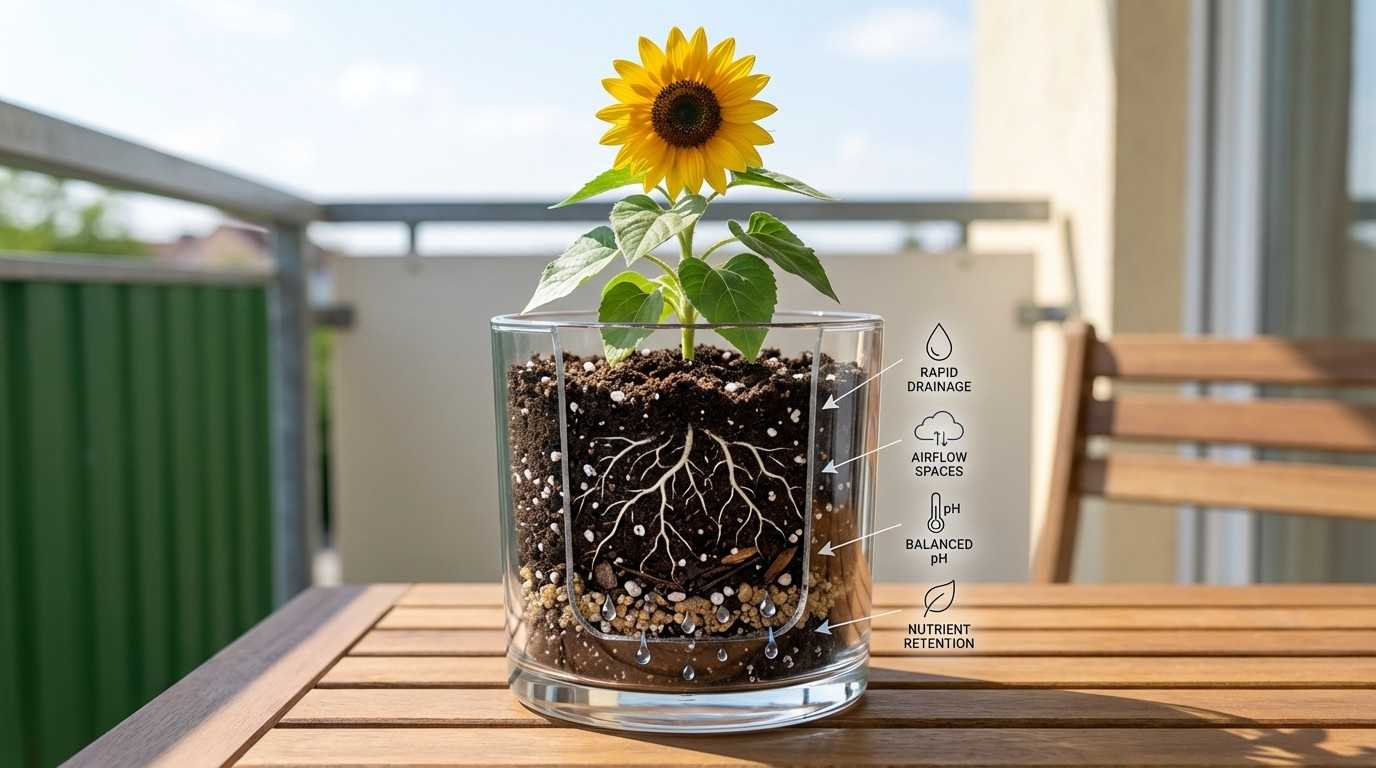
- Well-draining structure – roots must never sit in water.
- Loose, airy texture – allows roots to expand easily in a confined container.
- Slightly acidic to neutral pH – ideally between 6.0 and 7.5
- Good nutrient retention – especially important for container plants that get frequent watering.
- Adequate weight – especially for taller dwarf varieties that can get top-heavy.
The Ideal DIY Soil Mix for Dwarf Sunflowers in Containers
Rather than relying on generic potting soil straight from the bag, making your own blend gives you full control. Here’s a proven formula:
| Component | Ratio | Purpose |
|---|---|---|
| Quality potting mix (peat or coco-based) | 50% | Base structure and moisture retention |
| Perlite | 25% | Drainage and aeration |
| Coarse horticultural sand | 15% | Weight and drainage |
| Compost (well-aged) | 10% | Organic matter and slow-release nutrients |
Mix these thoroughly before filling your container. This blend drains well while retaining just enough moisture between waterings.
Should You Use Garden Soil?
Never use straight garden soil in containers for dwarf sunflowers. Garden soil compacts tightly in pots, restricts drainage, and creates an anaerobic environment that suffocates roots and promotes fungal disease. Even “good” garden soil behaves poorly when confined to a container.
Choosing the Right Container Size
The soil mix matters, but so does the container:
Minimum size: 12-inch diameter pot (3–5 gallons) for one plant
Ideal size: 14–16 inch diameter (5–7 gallons) for better root room and moisture stability
Must-have: Drainage holes – at least two or three at the bottom
Avoid dark-colored plastic pots in full-sun locations, as they absorb heat and can overheat the root zone. Terra cotta, fabric grow bags, or light-colored pots are better choices.
Pre-Mixing Fertilizer into the Soil
When you first prepare your container soil, this is the perfect time to mix in:
- A slow-release granular fertilizer (like Osmocote) at the manufacturer’s recommended rate.
- A small amount of worm castings (around 10–15% by volume) for microbial activity.
- A tablespoon of bone meal worked into the lower half of the container
This gives your dwarf sunflower a strong nutritional head start before you begin your liquid feeding schedule.
pH Management in Container Soil
Container soil can drift in pH over time – especially with heavy watering and fertilizer use. Test your soil pH every 4–6 weeks using an inexpensive soil pH meter or test strips.
- If pH is too high (alkaline): Add a small amount of sulfur or use an acidifying fertilizer.
- If pH is too low (acidic): Mix in a pinch of garden lime or dolomite
Keeping pH in the 6.0–7.0 range ensures your dwarf sunflowers can actually absorb the nutrients you’re feeding them – a critical but often overlooked detail.
Refreshing Soil Between Seasons
If you’re reusing containers season after season, refresh the soil each time. Old potting mix loses structure, becomes compacted, and depletes its organic matter.
Remove 50–70% of old soil and replace it with fresh mix. This prevents salt buildup and gives each new crop of dwarf sunflowers the cleanest possible start.
Frequently Asked Questions (FAQs)
Q1. How often should I fertilize dwarf sunflowers during the flowering stage?
During active flowering, apply a liquid bloom fertilizer every 10 to 14 days. Avoid fertilizing more frequently than once a week – this can lead to salt buildup and root burn, especially in containers.
If you’re using a slow-release granular, one application every 6–8 weeks is sufficient, but supplementing with diluted liquid feeding during heavy bloom periods is still beneficial.
Q2. Can I use Miracle-Gro All Purpose on dwarf sunflowers?
Yes, Miracle-Gro All Purpose (24-8-16) works fine during the vegetative growth stage. However, once your plant begins budding, switch to Miracle-Gro Bloom Booster (10-52-10) or a similar high-phosphorus formula. Using the all-purpose formula during flowering can cause excessive leafy growth at the expense of blooms due to its high nitrogen content.
Q3. Is Epsom salt good for dwarf sunflowers?
Epsom salt (magnesium sulfate) can be beneficial in moderation. Magnesium supports chlorophyll production and can intensify leaf color and overall plant vigor. Dissolve 1 tablespoon per gallon of water and apply once a month as a soil drench or foliar spray.
However, Epsom salt doesn’t replace a balanced fertilizer – it’s a supplement, not a complete nutrient source. Overuse can actually interfere with calcium absorption, so stick to monthly applications.
Q4. My dwarf sunflower has lots of leaves but no flowers – what’s wrong?
This is almost certainly a nitrogen excess problem. High nitrogen pushes plants into vegetative mode – more leaves, more stems, less blooming energy. Stop using any nitrogen-heavy fertilizer immediately and switch to a high-phosphorus bloom formula like 10-30-20 or bone meal.
Ensure your plant is also getting at least 6–8 hours of direct sunlight daily, as insufficient light is the other common reason for delayed flowering. The plant should begin budding within 2–3 weeks of the adjustment.
Q5. Do dwarf sunflowers in pots need more fertilizer than those in the ground?
Yes – significantly more frequent feeding is needed for container-grown dwarf sunflowers compared to in-ground plants. Every time you water, nutrients leach out through the drainage holes. In-ground plants have access to a much larger reservoir of soil nutrients and beneficial soil microbes.
For containers, plan on feeding every 10–14 days with liquid fertilizer during the growing season, and always start with a slow-release granular mixed into the soil to provide a baseline level of nutrition between feedings.
Final Thoughts
Growing dwarf sunflowers that bloom gloriously isn’t complicated – but it does require paying attention to what your plant is telling you. The right fertilizer at the right growth stage, paired with well-draining, nutrient-rich container soil, creates the conditions these compact flowers need to truly shine.
Start with a balanced approach during the vegetative phase, switch to a phosphorus-forward
bloom formula the moment you see buds forming, keep your soil pH in check, and never skip the drainage. Do those things consistently, and you’ll have dwarf sunflowers that bloom so enthusiastically you’ll wonder why you ever grew them any other way.
Happy growing – may your containers be golden all season long.